
 GL
GL
 SA
SA EG
EG UAE
UAE ZA
ZA
Short answer: all four are Gartner Leaders, so none is a weak choice. SAP EWM suits SAP-only landscapes, especially where the warehouse touches production. Infor WMS suits Infor ERP estates and operations of moderate complexity. Oracle Fusion Cloud Warehouse Management suits Oracle Fusion ERP estates. Manhattan ActiveWarehouse suits operations with genuine warehouse complexity at any size — and since Editions, that no longer means only the largest networks. The decision turns on four questions most shortlists never ask.
Supply Chain Junction is Manhattan's GeoPartner for Africa and the Middle East, with 90+ implementations across the GCC and Africa. We are not neutral. Everything below is sourced to each vendor's own material and linked so you can check it, and where SAP, Infor or Oracle is stronger — or Manhattan weaker — it says so.
Which WMS vendors are Gartner Leaders?
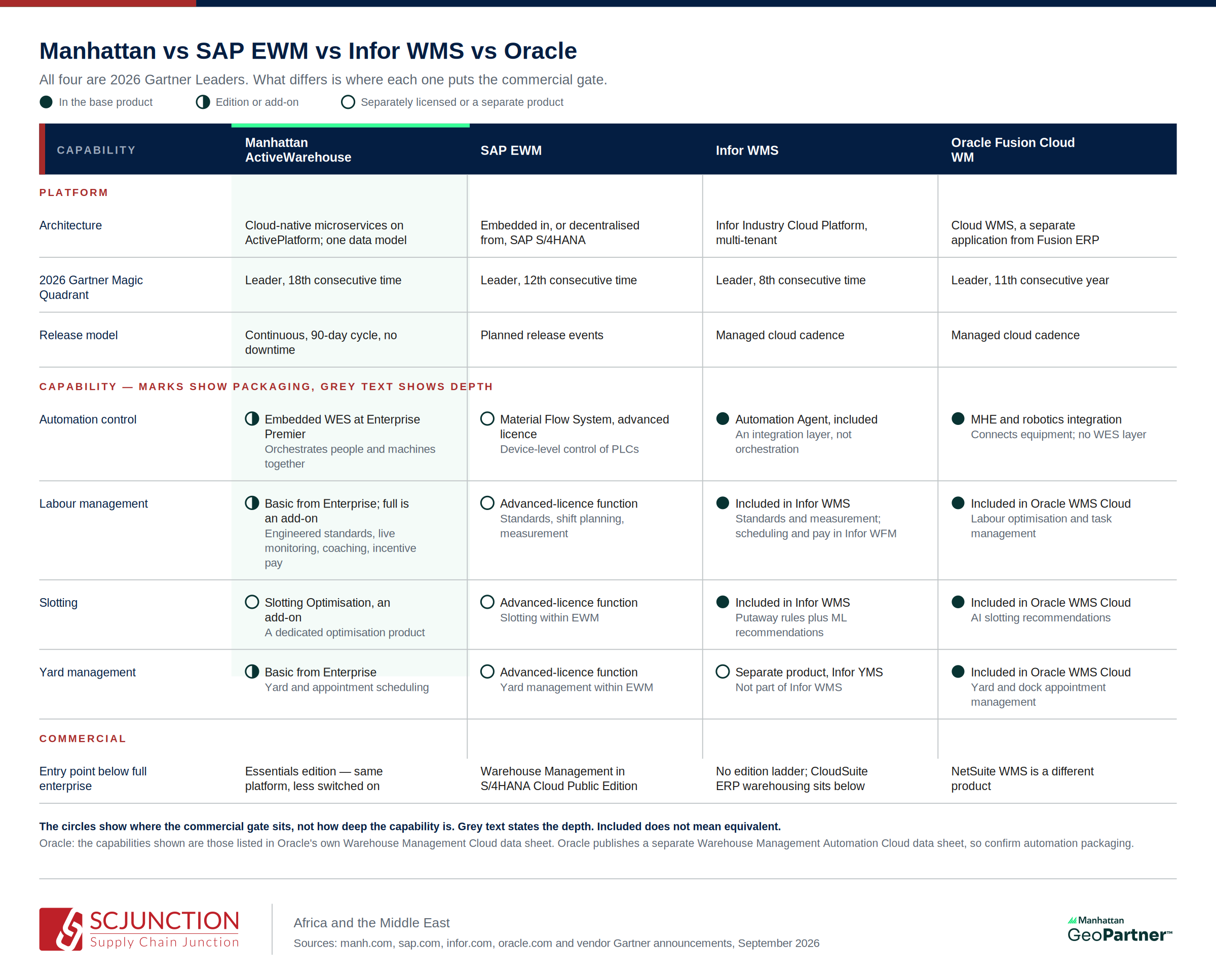
Manhattan Associates, SAP, Infor and Oracle were all named Leaders in the 2026 Gartner® Magic Quadrant™ for Warehouse Management Systems, published 29 April 2026 — Manhattan for the 18th consecutive time, SAP for the 12th, Oracle for the 11th consecutive year, Infor for the 8th. EPG, a familiar name on regional shortlists, was placed a Challenger for the fifth consecutive time. Gartner evaluated 18 vendors in total.
Be careful with that streak, because vendors oversell it: Blue Yonder was also named a Leader for the 18th consecutive time in the same report. Manhattan's run is joint-longest, not unique.
The more meaningful number is in the companion report. In the 2026 Gartner Critical Capabilities for WMS, Manhattan Active Warehouse Management scored highest of the 21 vendors evaluated for Level 3, Level 4 and Level 5 warehouse operations — the higher-complexity tiers.
So the quadrant does not decide this. Four Leaders and eighteen evaluated vendors is not a shortlist.
Question 1: Are you being quoted the product you think you are?
Three of the four vendors sell more than one thing called warehouse management, and the names are close enough that buyers regularly believe they have the Tier-1 product when they do not. This is the single most expensive misunderstanding in this market.
SAP. Advanced SAP EWM runs on S/4HANA Cloud Private Edition or on-premise. The warehouse capability in S/4HANA Cloud Public Edition — what GROW with SAP delivers — is called Warehouse Management, and SAP's own learning material describes it as based on EWM with a smaller functional scope.
Infor. Infor WMS is the Tier-1 product in the Magic Quadrant. Separately, the CloudSuite ERPs carry warehousing of their own: Infor LN has a Warehousing package plus a distinct "WMS Interface" for connecting to an external WMS. Infor's own documentation is blunt about the trade — a WMS-controlled LN warehouse cannot have locations, cannot have zones, and cannot use backflushing.
Oracle. Oracle Fusion Cloud Warehouse Management is the Tier-1 product and a distinct application from Oracle Fusion ERP. NetSuite Warehouse Management is a different product again, aimed at smaller operations, and Oracle's E-Business Suite carries its own warehouse product with its own documentation. Several Oracle warehouse options, one Magic Quadrant entry.
Manhattan. No ambiguity, for a structural reason rather than a virtuous one: Manhattan does not sell an ERP. One ActiveWarehouse, three editions, one platform.
Get the exact product name in the proposal, in writing. If your warehouse decision is being made inside an ERP programme rather than as a selection of its own, that distinction is the whole ball game, and we have written it up separately in Does GROW with SAP include SAP EWM?
Question 2: What is included, and what is licensed separately?
All of them gate capability commercially. The gates sit in different places, and this is where budgets break.
SAP. The basic EWM licence covers inbound, outbound, storage bin and task management, the RF framework, production integration and quality management integration. The advanced licence is separate and contains wave management, labour management, slotting, yard management, cross-docking, value-added services and the Material Flow System. Two things people miss: the basic-versus-advanced split applies only to embedded deployment, because decentralised EWM always requires the advanced licence — and running EWM against multiple ERP systems pushes you to decentralised.
Manhattan. Basic labour and yard management from the Enterprise edition. Full labour management, slotting optimisation and ActiveAgents are add-ons at every edition. The embedded warehouse execution system and order streaming sit at Enterprise Premier.
Infor. Labour management, wave management, value-added services and 3PL billing are part of Infor WMS rather than separate modules. Two caveats: yard management is a separate product, and labour scheduling, pay rules and payroll integration sit in Infor Workforce Management, a different product again.
Oracle. Broad inclusion within one product. Oracle's Warehouse Management Cloud data sheet lists yard management and dock appointment management; the product page adds labour optimisation, task management and integration to materials handling equipment, autonomous mobile robots, AGVs, conveyors and sortation; and Oracle markets AI-driven dynamic slotting. Oracle publishes a separate Warehouse Management Automation Cloud data sheet, so confirm how automation is packaged.
Ask all of them for a written inclusion list that names the licence or edition, not just the feature — and then ask for it priced against your scope, because inclusion lists and total cost are different questions.
Question 3: How is it configured, and what happens to that configuration at upgrade?
This is the functional difference that a feature matrix cannot show, and it decides both how long the project takes and what it costs you for the next decade.
The question is not what the system can do. It is how you get it to do it — and whether what you built survives the next release.
Note that this is the same decision as the release model, not a separate one. A vendor can only keep every customer on current code if none of them is running a modified core. Three of the four do that by design — Manhattan, Infor and Oracle all update centrally. SAP on-premise and in private cloud is the outlier, and it is the one deployment of the four where a customer can sit on an old version indefinitely and where modifying the core is normal practice.
Manhattan configures against embedded standard process, with a documented extensibility model of custom data attributes and extension points. Manhattan's own developer documentation states the design intent plainly: extensions are built without being impacted by, and without impacting, base application upgrades. In May 2026 it added Solution Design Studio, where business users write blueprints — business-language descriptions of how part of the operation should run — which the platform's agents then translate into live configuration within defined guardrails.
SAP EWM is configured through the IMG, and requirements outside standard process typically need ABAP. That line — where configuration ends and development begins — is exactly where upgrade liability is created. It is also why the advanced licence matters here: much of what you would configure sits behind it.
Infor WMS is configured through rules — allocation, wave, putaway, shift rotation — which covers a wide range of standard operations. Beyond those rules the customer picture is mixed: reviewers on Gartner Peer Insights report a lack of flexibility surfacing late in implementation, and independent review sites note that tailoring to specific workflows often needs Infor consultants or developers. One Gartner reviewer frames the constraint as a benefit, because it stops you customising the system. Both readings are fair, and which one applies depends entirely on how standard your operation genuinely is.
The honest trade-off: embedded best-practice process means you are choosing which standard process to run rather than designing one. That is fast, and it assumes your operation should be standard.
Be precise about what the alternative actually offers, though. It is not more functional depth — Gartner scored Manhattan highest of the 21 vendors evaluated for the most complex warehouse operations. It is more latitude to build. ABAP will do what you ask it to. You then own what you built, and it is the same code that turns the next upgrade into a project.
What to ask, and what to compare it against. Take one requirement you know is non-standard in your operation. Ask each vendor whether meeting it is configuration, an extension, or code — and what happens to it at the next upgrade. Then ask for a customer who has been through an upgrade with that customisation in place.
Make sure you are comparing like with like while you do it. If you are a single site running standard processes, the comparison is ActiveWarehouse Essentials against Warehouse Management in S/4HANA Cloud Public Edition, against NetSuite WMS, against an Infor CloudSuite ERP's own warehousing — and Essentials is the only one of those that is the full Tier-1 platform rather than a smaller product. If your operation carries real complexity, the comparison is ActiveWarehouse Enterprise against advanced SAP EWM, Infor WMS and Oracle Fusion Cloud Warehouse Management. Pricing Enterprise Premier against a competitor's core product tells you nothing except that the top of one range costs more than the middle of another.
One forward-looking point. Manhattan invested $138 million in R&D in 2024, around 13% of its $1.04 billion revenue, and stated it planned to increase that in 2025. What matters is not the absolute figure — SAP and Oracle are far larger companies — but that all of it goes to supply chain commerce. SAP, Oracle and Infor allocate R&D across ERP, finance, HR and much else, and none of them discloses what share reaches the warehouse. If you expect to own this system for a decade, it is worth asking each vendor what proportion of their development budget is spent on warehouse execution specifically.
Question 4: Who will actually be in the building?
Global comparisons stop at the vendor boundary. The things that derail a WMS programme in Riyadh, Dubai or Johannesburg sit just outside it:
- Customs status as an inventory attribute. Can the system hold duty-suspended free-zone stock alongside duty-paid stock in one facility, through receiving, putaway and picking? Ask for a demo, not an assurance.
- Your actual carriers. "Direct parcel connectivity to major carriers" means the global integrators. Regional carriers are an integration with a cost and a timeline.
- Your peak calendar. Ramadan, Eid and White Friday, not Black Friday. Standard vendor sizing assumptions are usually wrong here.
- The architecture underneath, not the label on it. All four are sold as cloud, so ask what that means in each case. Is every customer running the same code, or is this a hosted instance of an older product? Does the vendor's extensibility model keep your configuration intact through updates, or does your configuration live in the core? How often do updates arrive, and do they require your testing time and a change window? Those answers determine what the system costs you to own, and they differ far more between these four than the feature lists do.
- Room to grow without changing systems. The warehouse you are buying for today is not the one you will run in five years. Ask each vendor what happens when volume doubles, a new channel opens, or you add a site: is that a configuration change, a licence step, a different product, or a reimplementation? Manhattan's edition ladder exists precisely so a site can start on Essentials and move up the same platform. With the others, ask where the step change falls and what it costs.
Then ask each vendor: who configures this, in which time zone, in which language, and can you give me a reference in my country rather than my continent?
Those answers vary more between vendors here than anything on the comparison table.
Where Manhattan is weaker
A comparison by a Manhattan partner with nothing critical to say is not worth reading.
- Cost at the top of the range. Manhattan has historically been the expensive option, and its commercial model was built for businesses several times the size of a single-site distributor. Editions changes where you enter the range; it does not change what the top of it costs. Enterprise Premier is an enterprise investment and will price like one. The mistake to avoid is comparing Enterprise Premier against a competitor's core product — compare Essentials or Enterprise against their equivalent instead.
- Capability is arranged differently, and inclusion lists mislead in both directions. Infor and Oracle put labour, wave and yard capability inside one product, which reads well on a licence line, while Manhattan spreads capability across three editions plus add-ons, which reads worse. What a licence line cannot show is depth. Infor's labour management is standards and measurement, with scheduling and pay in a separate product. Oracle's is labour optimisation and task management. Manhattan's full labour product is engineered standards, live performance monitoring, coaching and incentive pay — and it is an add-on precisely because most operations do not need it. For a standard mid-sized warehouse, that depth is cost you should not be carrying. For an operation that genuinely needs it, the comparison is not close. Compare against what your operation actually requires.
- No ERP. The flip side of independence: Manhattan cannot give an SAP manufacturer what embedded EWM gives them — warehouse and finance in one database, no interface at all.
- Gartner publishes Cautions for every Leader, Manhattan included. Read them alongside the Strengths.
So which one?
SAP EWM if you want one vendor and one database — the warehouse inside the ERP, with finance and production on the same data. Price the advanced licence properly, because most of what makes EWM competitive sits inside it.
Infor WMS if Infor is already your ERP, or your operation sits at moderate complexity — what Gartner classifies as a Level 3 warehouse — where a single configurable product covers the requirement without needing depth beyond it.
Oracle Fusion Cloud Warehouse Management if Fusion is your ERP and you want warehouse and ERP from one vendor. Oracle covers labour, yard and slotting inside the product at a level suited to standard operations — test that against your actual requirement rather than assuming it is equivalent to a specialist system.
Manhattan ActiveWarehouse at the rung your operation actually needs. Essentials for a single site running standard processes that still wants a Tier-1 platform rather than an entry-level product. Enterprise where complexity is real — multiple channels, retailer compliance, a growing e-commerce line, more than one site. Enterprise Premier where people and machines have to be orchestrated together. The point of the ladder is that you are not buying a smaller product at the bottom of it, and you are not replatforming when you outgrow it.
That last point is the change most shortlists have not caught up with. Manhattan is no longer aimed exclusively at the largest networks. It is aimed at operations with genuine warehouse complexity at any size, on the basis that those businesses are the ones a good WMS helps grow. Complexity, not headcount or revenue, is what should decide this. A single-site distributor running three channels and retailer compliance has more need of a real WMS than a much larger operation shipping full pallets to one customer.
Supply Chain Junction is the Manhattan Associates GeoPartner for Africa and the Middle East, with consultants based in the GCC and South Africa. If you want a view on which rung your operation actually sits on, book a short call.
Frequently asked questions
Which is better: Manhattan ActiveWarehouse, SAP EWM, Infor WMS or Oracle?
All four were named Leaders in the 2026 Gartner Magic Quadrant for Warehouse Management Systems, so none is a weak choice. SAP EWM suits SAP-only landscapes, particularly where the warehouse touches production. Infor WMS suits Infor ERP estates and operations of moderate complexity. Oracle Fusion Cloud Warehouse Management suits Oracle Fusion ERP estates. Manhattan ActiveWarehouse suits operations with genuine warehouse complexity, and since its three editions launched that includes single-site operations rather than only large networks.
Is Manhattan Associates a Gartner Leader?
Yes, for the 18th consecutive time in the 2026 Magic Quadrant for Warehouse Management Systems. Blue Yonder was also named a Leader for the 18th consecutive time in the same report, SAP for the 12th and Oracle for the 11th. In the companion Critical Capabilities report, Manhattan Active Warehouse Management scored highest of 21 vendors for Level 3, Level 4 and Level 5 warehouse operations.
Does SAP EWM include labour management and slotting?
Not in the basic licence. Labour management, slotting, wave management, yard management, cross-docking, value-added services and the Material Flow System are advanced-licence functions. The basic licence covers inbound, outbound, storage bin and task management, the RF framework, production integration and quality management integration. The split applies only to embedded deployment — decentralised EWM always requires the advanced licence.
Does Manhattan include labour management and slotting?
Basic labour and yard management are included from the Enterprise edition. Full labour management and slotting optimisation are add-ons at every edition, as are ActiveAgents and Agent Foundry. Most small and mid-sized warehouses do not need them and should not buy them. The operations that genuinely benefit tend to share a profile — upwards of around 300 warehouse staff, high daily order volumes, high SKU counts and pronounced seasonality. If that describes your operation, cost them in from the start, because that is where the labour savings sit. If it does not, they are not a cost you are carrying.
Which WMS includes the most in its base product?
Infor and Oracle put more capability inside a single product. But inclusion and suitability are different questions, and the comparison only means something against your own requirement. Infor's and Oracle's labour capability is standards and task measurement; Manhattan's full labour product adds engineered standards, live performance monitoring, coaching and incentive pay, and is an add-on precisely because most operations do not need that depth. Manhattan's editions work the other way round — you buy the rung your operation needs. Essentials for standard single-site operations, Enterprise for real complexity, Enterprise Premier where people and machines are orchestrated together. Compare what each vendor quotes against what you will actually use.
Is Infor WMS cheaper than Manhattan ActiveWarehouse?
Infor's licence line is simpler to read, because labour management, wave management and 3PL billing sit inside one product rather than in editions and add-ons. That is not the same as a lower total cost of ownership, and the licence is usually the smaller half of the number. Implementation effort, integration, upgrade cost over a decade and the capability you end up buying separately all belong in the comparison — Infor sells yard management separately, workforce planning and pay sit in a different Infor product, and customers report that tailoring to non-standard workflows needs Infor consultants or developers. Compare ActiveWarehouse Essentials or Enterprise against Infor WMS rather than pricing Enterprise Premier against it, and build the number properly. Our guide to justifying ROI on a WMS sets out how.
Which WMS is best for a 3PL serving multiple clients?
Manhattan, Infor and Oracle all handle multi-client, multi-site operations. Infor includes 3PL billing inside the WMS. Manhattan sells Billing Management as a separate solution but publishes an edition ladder, so a small site won by a 3PL can be right-sized rather than deployed at enterprise scale — which matters more than billing packaging once you are winning contracts of different sizes. Oracle carries 3PL heritage through the LogFire acquisition in 2016 and markets Warehouse Management Cloud to 3PLs, though the detailed multi-tenancy and billing documentation we could verify is for Oracle's E-Business Suite warehouse product rather than the Cloud one, so confirm which you are being quoted. SAP EWM is the weakest of the four commercially here, because running against multiple ERP systems drives you to decentralised deployment, which always carries the advanced licence.
Which WMS is best for warehouses in the UAE or Saudi Arabia?
All four are deployed in the region and all are 2026 Gartner Leaders, so the choice turns on fit with your operation rather than on the vendor list. Start by establishing what your warehouse actually has to do well — throughput, order profile, channel mix, accuracy, labour productivity, seasonality — and test each vendor against that rather than against a generic feature list. Our warehouse KPI benchmarking checklist is a practical starting point. Then ask who configures the system, in which time zone, in which language, and for a reference in your country rather than your continent.
Can Manhattan ActiveWarehouse integrate with SAP S/4HANA?
Yes, through APIs and pre-built connectors. Many operations run S/4HANA for finance and a specialist WMS in the warehouse, precisely so the warehouse is not constrained by the ERP's release cycle.
Is EPG a Gartner Leader?
No. EPG (Ehrhardt Partner Group) was placed a Challenger in the 2026 Gartner Magic Quadrant for Warehouse Management Systems, its fifth consecutive Challenger recognition. Challenger is a legitimate placement and EPG competes actively in this region, particularly on price — it is simply not a Leader placement, which is worth knowing if a shortlist has been assembled from vendor marketing.
Is Infor the same company as Infios?
No. Infios is the rebranded Körber Supply Chain Software, renamed in March 2025, and a separate WMS vendor. The names are easily confused in search results and shortlists.
How long does a WMS implementation take, and what makes it faster?
Timelines are driven less by the software's features than by its configuration model. A system configured against embedded standard process is faster to deploy than one where every requirement is designed from first principles, because you are selecting a process rather than building one. What does not compress on any platform is master data quality, integration, physical site readiness and change management — those become the critical path once configuration stops being the bottleneck.
How do I choose a WMS?
Work through four questions, because each one surfaces a difference a feature matrix hides. Which product are you actually being quoted, given that three of the four major vendors sell more than one thing called warehouse management. What is included and what is licensed separately, priced against your scope rather than read off an inclusion list. How the system is configured, and whether that configuration survives the next upgrade — the real functional difference between these platforms is not what they can do, it is how you get them to do it and what that costs you at every release for a decade. And who will configure and support it in your country, in your time zone.
Those four separate the vendors far more sharply than a capability checklist does, which is why a scored feature matrix so reliably produces a shortlist of four Leaders and no decision. If you are earlier than that and still working out whether your current system is the problem, start with how to know if your warehouse management software is a good fit for your business.

Share



 Download case study